
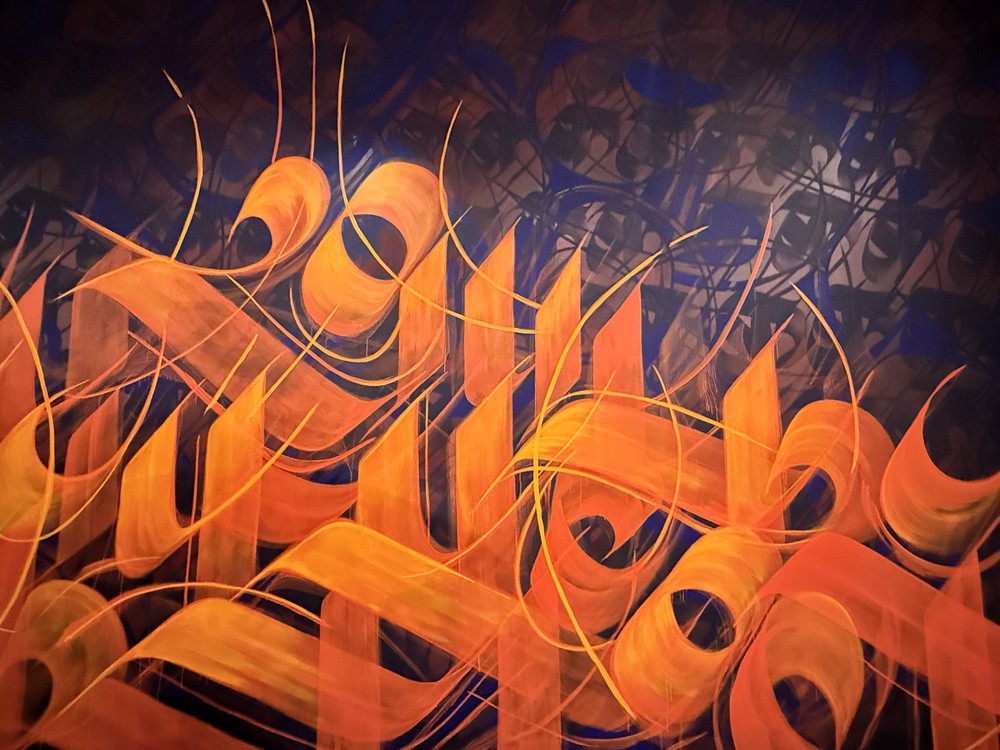
Sneha Shrestha, along with three other artists (1), won the 2025 James and Audrey Foster Prize, an award given biennially by the Institute of Contemporary Art/Boston (2). While Nepal did not provide Shrestha with real-life exposure to the contemporary art-world, she incessantly and spontaneously drew and painted as a young person. That the resulting self-created capability harbored real promise became evident upon her becoming a college student in the United States. Subsequently, while moonlighting as a painter and graffiti artist as she earned a master’s degree in education from Harvard University, Shrestha decided to become a career-artist. She has since become one, even as she works part time at the University’s Lakshmi Mittal Institute of South Asian Studies. By now, Shrestha is making an original contribution to calligraphic abstraction in the twenty-first century.
In announcing the 2025 Foster Prize, ICA/Boston said that the selection of the awardees was based on studio visits to over 50 Boston-area artists. The Institute said that the four prize recipients work across multiple media and utilize materials and processes that “uniquely connect their local and global roots.” They exemplify the “internationalism of Greater Boston.” The exhibition showcasing their works, curated by the ICA’s Tessa Bachi Haas, opened on August 28, 2025, and will conclude on January 19, 2026.
Shrestha’s exhibition display, housed in a large tailormade space, comprises four bodies of work: a mural painting, “Worlds Apart,” occupying a wall 15 feet high; a pair of two seven-feet tall paintings expressing her nostalgia for home; a set of 21 paintings selected from a series she has named “Celebration” to mark the immigration journey she has embarked upon; and a parasol-like sculpture hanging from the ceiling in the center of the room. “Worlds Apart” calls for sustained attention since the artist regards it as the centerpiece of her ICA exhibit. But, before we discuss the mural, let’s go back to Shrestha’s formative years in Nepal.
While contemporary art was absent from the world in which Shrestha grew up, exposure to Nepalese classical art did occur through periodic family visits to Hindu temples and Buddhist monasteries, and the celebration of rites and festivals, mostly associated with the seasons and their impacts on agriculture (3). Dominant in the depiction of natural objects in this art were various forms of stylization. Particularly striking was cloud stylization, especially the evocation of embedded energy arising from the link between clouds and monsoon rain. Looking long and deeply into “Worlds Apart,” you’ll likely discern emerging from this immersive, transporting painting the imprint of a sensibility affected by the classical Nepalese art Shrestha saw as a young person. Consider the painting’s energy and expressive vitality. Consider also its elegance and buoyancy.
“Worlds Apart” is a painting of intricate complexity. You first see the colors and forms depicted by the artist in the light falling on the painting from the sources of illumination in the room. But, thanks to Shrestha’s painterly ingenuity, you get the impression that the work is also lit from within, in its north-east but also elsewhere. The principal actors in the drama unfolding before you are the orange, fractal-like calligraphic forms that seemingly swirl, furl, float, and ascend against two layers in the background: a layer of furtive, allusive cobalt-blue calligraphic objects, and an additional layer of grey-black letters representing ‘ka’, the first letter of the Devanagari script, which the Nepali language shares with Sanskrit and other Indic languages. It is this script which Shrestha celebrates in her art, and it is the ‘ka’ layer---symbolizing home, beginnings, the start of communication---that she primarily illuminates from within. “Worlds Apart” owes its depth and unity to both this virtual light and the light falling frontally on the painting. Two worlds, Shrestha’s childhood world and the new world she has chosen for herself, come together. This coalescence also emerges from the dance of the painting’s calligraphic forms, and their blending of symmetry and adjacency to symmetry. Her Devanagari-based fractals are not self-identical, but self-similar, their pattern akin to fractals that appear in nature---another reason why “Worlds Apart” is such an alluring work of art (4).